
What actually happens in a session
If you're wondering what's actually involved in the Make Your Own Cymbal session, here's a brief walkthrough — from the moment you arrive to the moment you leave with a cymbal you've made yourself.
STEP ONE
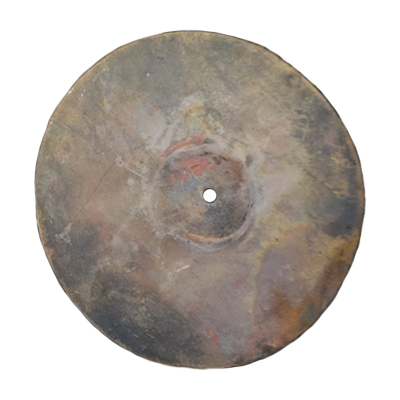
It starts with a blank
The cymbal blank is a flat disc of B20 bronze (20% tin, 80% copper) sourced from a traditional Turkish cymbal foundry and ordered to my specification. This alloy (combination of metals) is used in the finest cymbals in the world.
The bell of the cymbal (central cup / dome) is pressed into the red-hot metal at the factory. We only do cold work in the session, namely hand-hammering and lathing.
Before we begin, we talk about what you'd like to make and how we get there. You're welcome to document the process through sound recordings, pictures and videos. Please feel free to share as much or as little as you like to social media etc.
The bell of the cymbal (central cup / dome) is pressed into the red-hot metal at the factory. We only do cold work in the session, namely hand-hammering and lathing.
Before we begin, we talk about what you'd like to make and how we get there. You're welcome to document the process through sound recordings, pictures and videos. Please feel free to share as much or as little as you like to social media etc.
STEP TWO
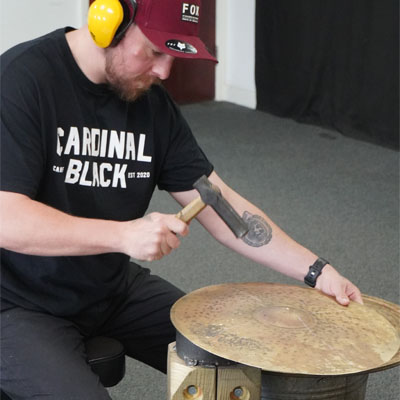
Hand-hammering
This is where the cymbal gets its shape and character. Every hammer strike imprints the metal — compressing it, stretching it, and adding surface area. This grows the profile of the cymbal, which results in the changing sound.
The hammering is done in multiple overlaid passes. We practice first to get the feel, and you'll quickly find your groove. You'll see and hear the cymbal change as you work, this is where things start coming alive.
You set the pace! The session is designed to be relaxing and fun. We take plenty of breaks and you can ask as much or as little as you like about the theory behind the work.
Hand-hammering can be shared — I can demonstrate and help, or I can stay hands-off and guide you.
Ear defenders are provided and gloves are available.
The hammering is done in multiple overlaid passes. We practice first to get the feel, and you'll quickly find your groove. You'll see and hear the cymbal change as you work, this is where things start coming alive.
You set the pace! The session is designed to be relaxing and fun. We take plenty of breaks and you can ask as much or as little as you like about the theory behind the work.
Hand-hammering can be shared — I can demonstrate and help, or I can stay hands-off and guide you.
Ear defenders are provided and gloves are available.

We take breaks
The workshop has a kitchen area and comfortable sofa for tea and coffee (provided). The session is relaxed, and you set the pace. There's a fridge if you wish to bring lunch / snacks. Dairy and non-dairy milk will be available, please let me know of any dietary requirements.
STEP THREE
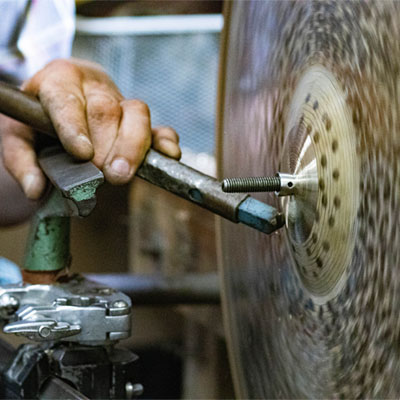
Lathing
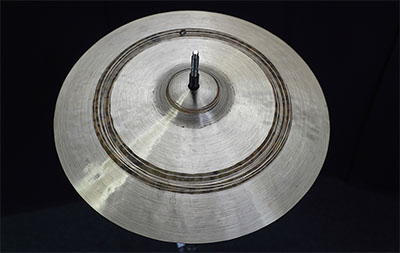
Lathing cuts away the surface of the bronze to reveal the shiny metal underneath and add the grooves you'll see on most cymbals. This is where the magic happens and the cymbal starts sounding bright and alive.
We work in stages, testing the cymbal between passes to hear how things change. How far we go is up to you, and I'll be there to guide you, explaining what happens by lathing in certain areas, or leaving parts unlathed.
All PPE is provided, we'll practice and talk through how to work safely. I stay in charge of the running of the motor, meaning I can stop if needed and discuss any necessary changes.
This part of the process is fun and very satisfying. It's where we get to see and hear changes occurring quickly as we reach the finished cymbal.
We work in stages, testing the cymbal between passes to hear how things change. How far we go is up to you, and I'll be there to guide you, explaining what happens by lathing in certain areas, or leaving parts unlathed.
All PPE is provided, we'll practice and talk through how to work safely. I stay in charge of the running of the motor, meaning I can stop if needed and discuss any necessary changes.
This part of the process is fun and very satisfying. It's where we get to see and hear changes occurring quickly as we reach the finished cymbal.
STEP FOUR
Testing and finishing
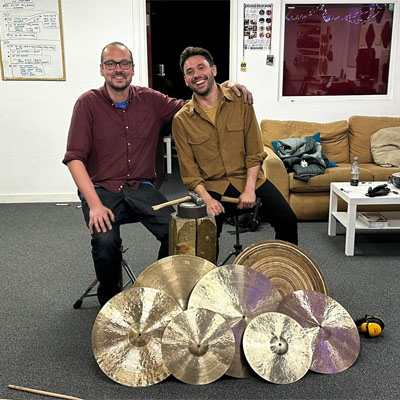
We take the cymbal to a stand and you play it! You'll hear your brand new handmade cymbal for the first time.
We can talk about how and why it's making its unique sound, and if you feel anything needs tweaking, we take care of it with a little extra hammering and / or lathing. We only finish when you're happy!
One thing to note — the bronze will rest over a period of a few days, meaning the sound of the cymbal at the end of the session will be a slightly choked version of what it will become after resting. I will guide you through what to expect and how to listen knowing what's to come. In essence, the sound becomes a touch "sweeter", the sustain becomes longer and overall it will sound more open and expressive.
The cymbal doesn't need special care while resting, it can be played and enjoyed freely!
We can talk about how and why it's making its unique sound, and if you feel anything needs tweaking, we take care of it with a little extra hammering and / or lathing. We only finish when you're happy!
One thing to note — the bronze will rest over a period of a few days, meaning the sound of the cymbal at the end of the session will be a slightly choked version of what it will become after resting. I will guide you through what to expect and how to listen knowing what's to come. In essence, the sound becomes a touch "sweeter", the sustain becomes longer and overall it will sound more open and expressive.
The cymbal doesn't need special care while resting, it can be played and enjoyed freely!
Then you take it home
A finished, playable, professional-grade handmade cymbal. Made by you. No two are the same.
You have the option to add your name, the date, a personal message or a graphic of your choosing with either a hand-held engraver or my laser engraver. Or leave it blank and let the sound do the talking!
You have the option to add your name, the date, a personal message or a graphic of your choosing with either a hand-held engraver or my laser engraver. Or leave it blank and let the sound do the talking!
★★★★★
"Dave was an excellent teacher and can customise the experience so you get what you want out of the day. Dave is a friendly individual with a wealth of knowledge and will answer any questions you have. You get what you put into the experience and I can't recommend enough to anyone with even a passing curiosity - even as a total beginner."
Kane Gent, May 2025